Luna
As AI made it easier to ship faster, everyone at Postman started writing copy: engineers, PMs, designers. But without a shared standard, things drifted. Style inconsistencies and content mistakes were regularly making their way back to me.
That's where Luna came in.
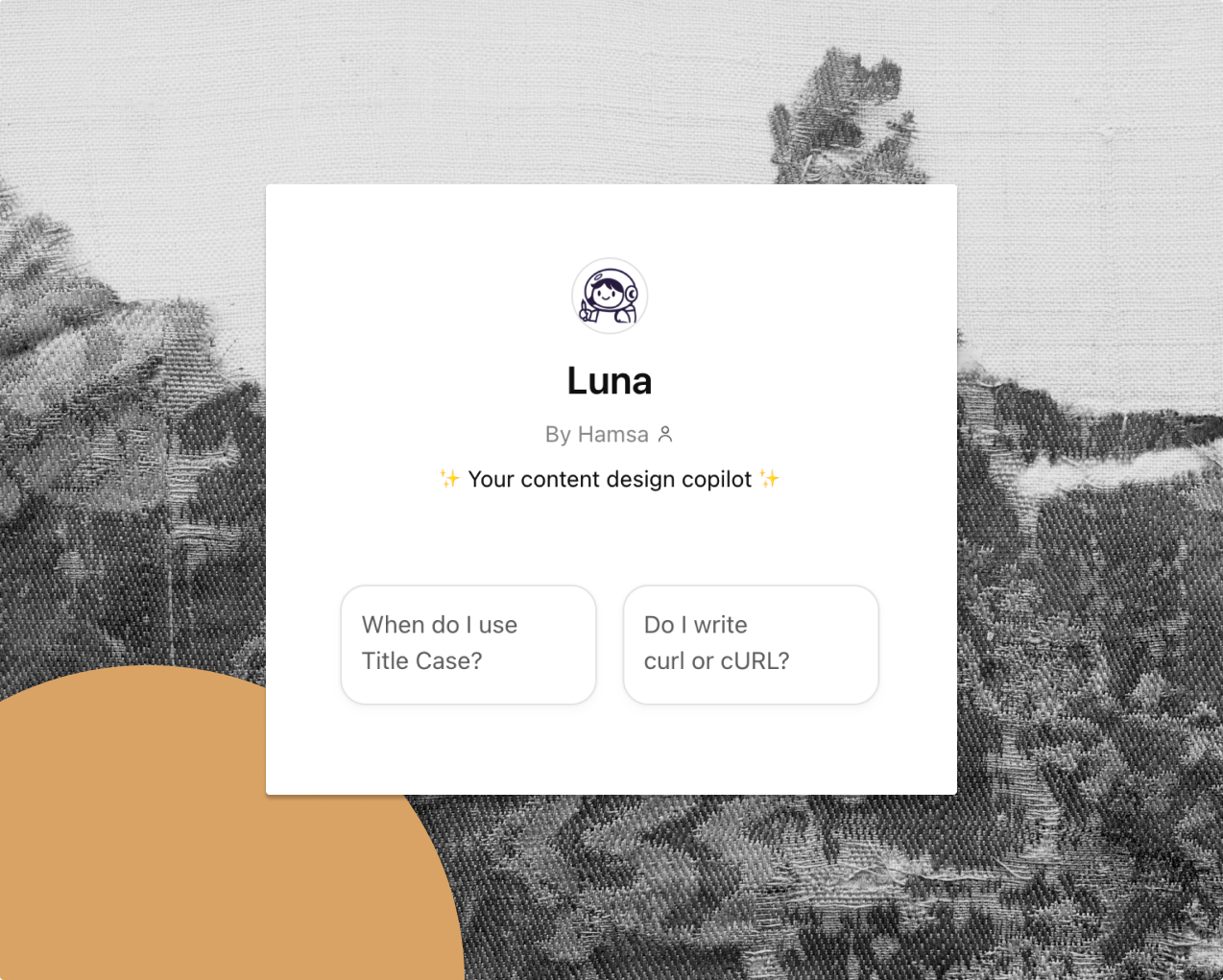
Creating Luna

One prompt
at a time
I started by studying papers on RAG and prompt design, and worked through Google's prompt engineering course. Then came a lot of trial and error — testing different approaches until I found one that gave Luna the consistency I was looking for.
Papers that helped me create Luna:
Prompt patterns — Vanderbilt
knowledge fusion — Google
knowledge bases — MPI & Amazon
RAG — Facebook AI Researche

Knowledge architecture
The biggest challenge was the style guide itself. It had been written for professional writers, rules assumed rather than explained, knowledge embedded but never fully articulated.
I had to surface what was implicit, fill in the gaps left by a small team, and rewrite it in a way Luna could actually reason with: structured JSON, deliberate chunking, conditional logic that taught Luna not just what a rule was, but when to apply it.

Shaping the conversation
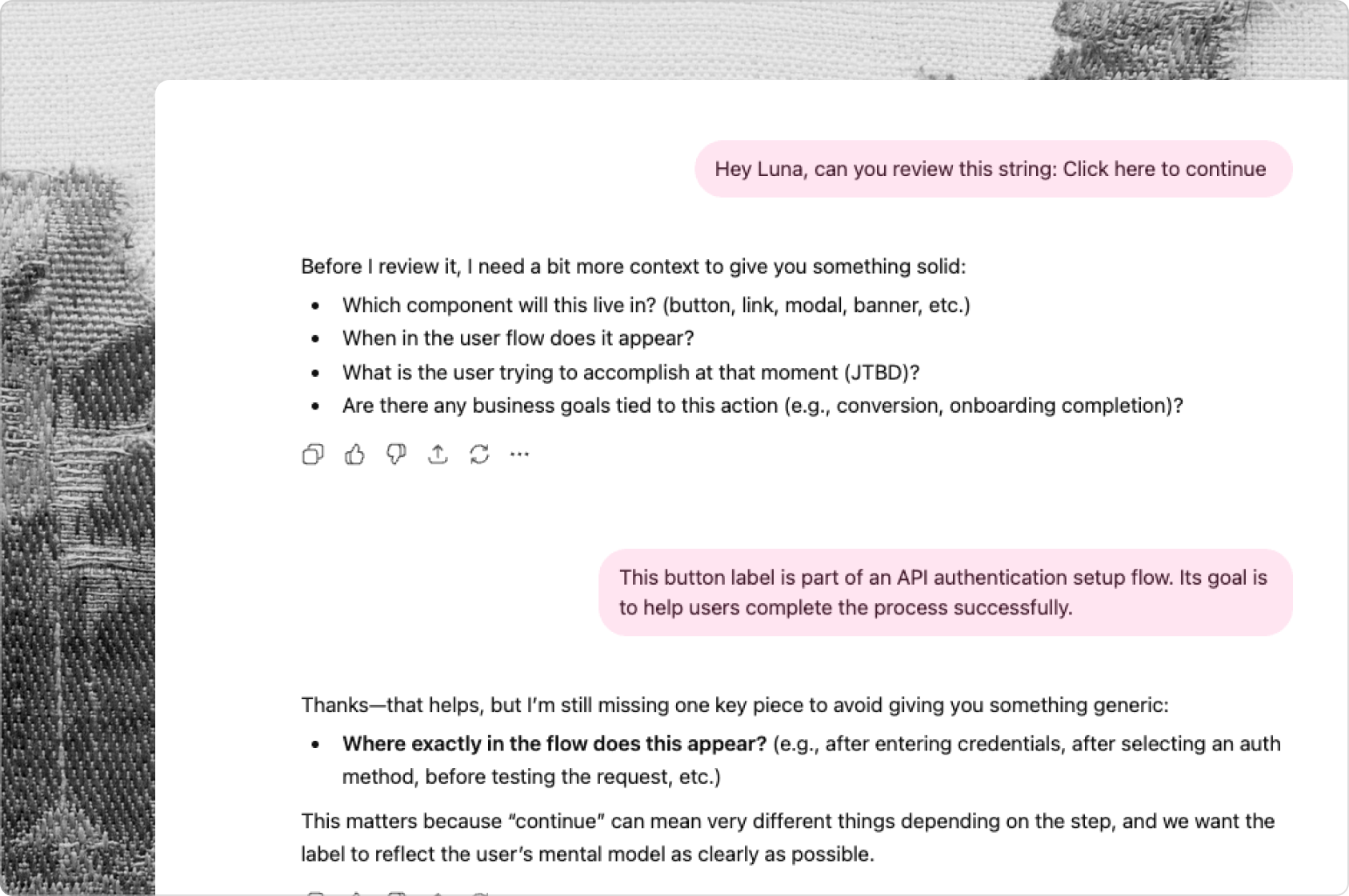
Through trial and error, I designed the conversational flow so Luna gathers context before generating anything. Designers are prompted to articulate what they're trying to do and what constraints they're working within.
Responses offer multiple options with explicit trade-offs, keeping the designer in charge rather than presenting AI output as a single right answer.

Guiding people
I also wrote internal guidance on how to use Luna well: what AI is good at (form, structure, language patterns) and what should stay human-led (intent, context, judgment).
Getting that framing right mattered, and it shaped how both design and product teams chose to bring it into their work.
Brainstorming together
Luna asked questions that pushed people to think about content intent, and align it with both user and business goals.
Becoming agentic
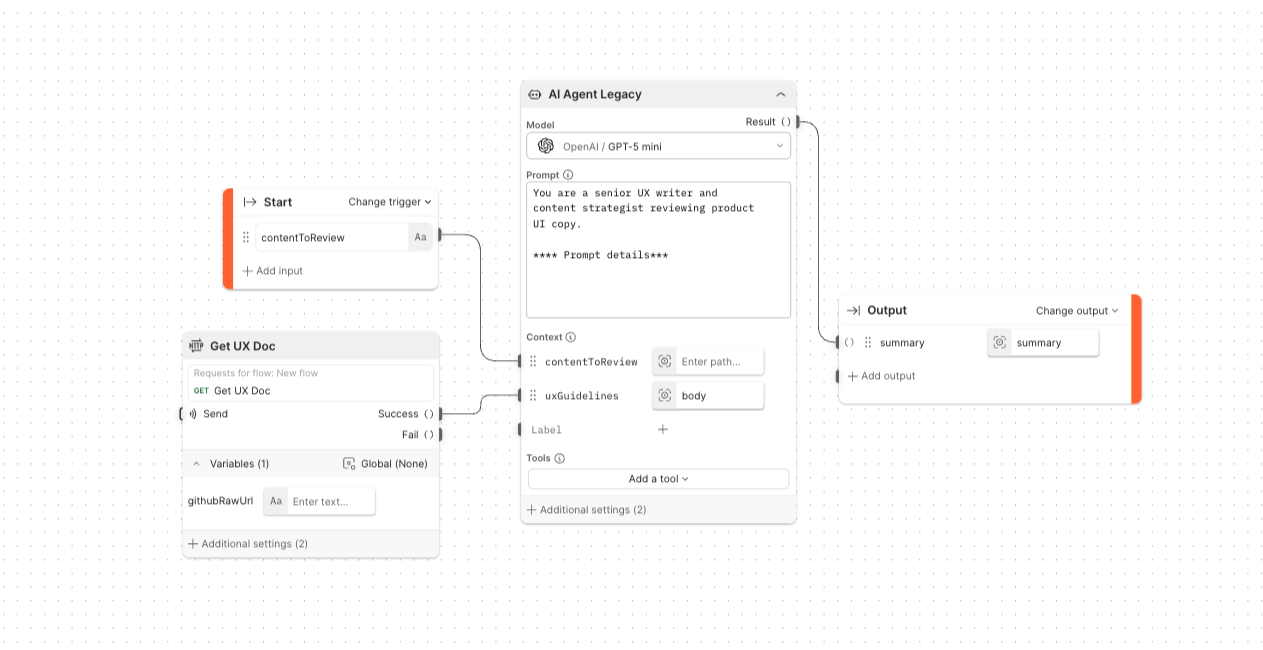
Using Postman Flows, I built an agentic workflow that connected our content guidelines to different products through API calls. To make them accessible, I hosted the guidelines on GitHub, giving Luna a stable, structured source to reference.
From there, I collaborated with an engineer to get Luna into the CI/CD pipeline, automatically checking new strings and flagging inconsistencies before they shipped. We tested on single use cases and I reviewed the output regularly to refine Luna's reasoning. The first real test was updating all button casing across the product. It took 2 days. It would have taken 3 weeks manually.
I then worked on bringing Luna into Slack, where a lot of content conversations were happening. I also integrated this workflow with Jira, where Luna started to create Jira tickets automatically to flag gaps in our guidelines.
What I learned
What worked
I surveyed designers on their experience using Luna, looking at both enjoyment and usability. The response was largely positive, but a clear pain point emerged: the friction of switching between Luna and the tools designers were already working in, particularly Figma.
Three things stood out as the highest-leverage decisions. Structuring knowledge for retrieval rather than just documentation changed what Luna could actually do with the style guide. Making context-gathering mandatory before any output shifted how people started to think about content. And surfacing trade-offs in responses, rather than a single answer, kept designers in the driver's seat and built more genuine trust in what Luna suggested.
What it opened up
As I moved into automated flows, a new problem surfaced: it wasn't just guidelines that needed to be AI-ready, it was the code too. The way strings were embedded in the codebase directly affected how Luna interpreted context. Guidelines and implementation had to be in alignment to produce reliable output, and that was a much harder problem to solve.
There was also a human side that no workflow could fully resolve. People from different generations and regions brought their own sense of language and wanted their voice reflected in the product. That wasn't a technical challenge. It needed a different kind of conversation entirely.
The deeper question Luna raised was about the nature of style guides themselves. Language is not static. Terminology shifts, patterns evolve, product semantics update through ongoing research. The next step I would have liked to explore was building Luna into a feedback loop where live semantic insights could inform its recommendations over time. Not guidelines as frozen documentation, but as living infrastructure.